Choosing among the best AI models for business in 2026 is not simply a matter of picking the model with the highest benchmark score. A support team may need speed and low cost, a software team may need repository-level coding, while a privacy-focused business may prefer an open or locally deployed model.
GPT-5.6, Claude, Gemini, Grok, GLM, DeepSeek, Qwen, MiniMax, and other model families lead different workloads. Some are stronger at reasoning or coding, while others stand out for multimodal work, latency, price, tool use, or private deployment.
The same model can power a chatbot, copilot, or AI agent depending on the tools, memory, permissions, and workflow built around it. The real decision is not only which model is most capable, but which one can complete your task reliably, safely, and at a sustainable total cost.
This guide compares the best AI models for business by workload, benchmark evidence, cost, security, deployment options, local use, and support for chatbot and AI agent workflows.
| Research note |
| Research cutoff: July 11, 2026. Model aliases, preview access, prices, leaderboards, data-retention terms, and regional availability can change. Recheck the linked official pages before procurement or deployment. |
There is no single best AI model for every business in 2026. The strongest choice depends on the workload:
Cost varies widely. In the report’s example of 1 million input tokens plus 250,000 output tokens, estimated token-only cost ranges from about $0.62 to $22.50, before search, tools, retries, monitoring, or human review.
Most businesses do not need the strongest model for every task. A routed setup can use a lower-cost model for routine work and reserve a frontier model for difficult or high-risk cases.
In one support scenario, routing 80% of conversations to Gemini 3.1 Flash-Lite and the remaining 20% to GPT-5.6 Sol reduced the estimated token-only cost from about $275 to $66, or roughly 76%. Actual savings depend on conversation length, routing accuracy, retries, tools, and human review.
An AI model is the reasoning engine, while “chatbot” and “agent” describe the system built around it. In a chatbot, the AI model mainly answers messages. In an AI agent, it is connected to tools, task state, permissions, and a control loop that can move work forward.
Calling one tool once does not automatically make a system an agent. The shift happens when it can choose and sequence several actions, check the results, adjust its next step, and stop or request approval when needed.
The chart shows how close the leading AI models are in 2026. Claude Fable 5 sits at the top with a score of 60, followed closely by GPT-5.6 Sol at 59.
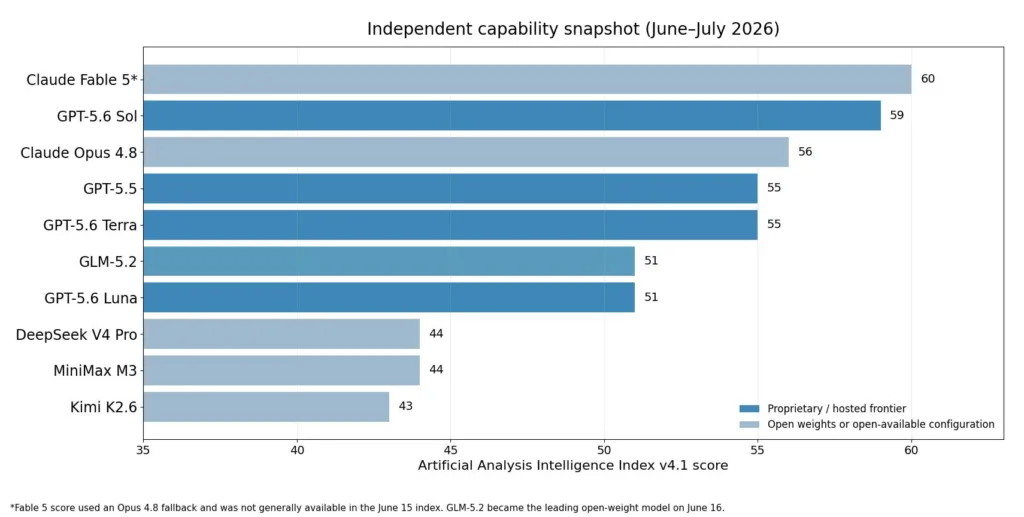
Source: Artificial Analysis. Higher is better.
For a business, the benchmark is most useful as a starting point. Fable 5 and GPT-5.6 Sol belong in the high-performance shortlist.
Terra, Luna, GLM-5.2, DeepSeek V4 Pro, and MiniMax M3 may be more suitable when cost, speed, privacy, or deployment flexibility matters more than the highest possible score.
Benchmarks can point you in the right direction, but they should not choose the model for you. The best option is the one that performs well inside your actual workflow, keeps mistakes low, reduces the need for manual fixes, and delivers results at a cost that makes sense for your business.
This leaderboard shows which AI models people preferred in real conversations, not which model is objectively the most accurate.
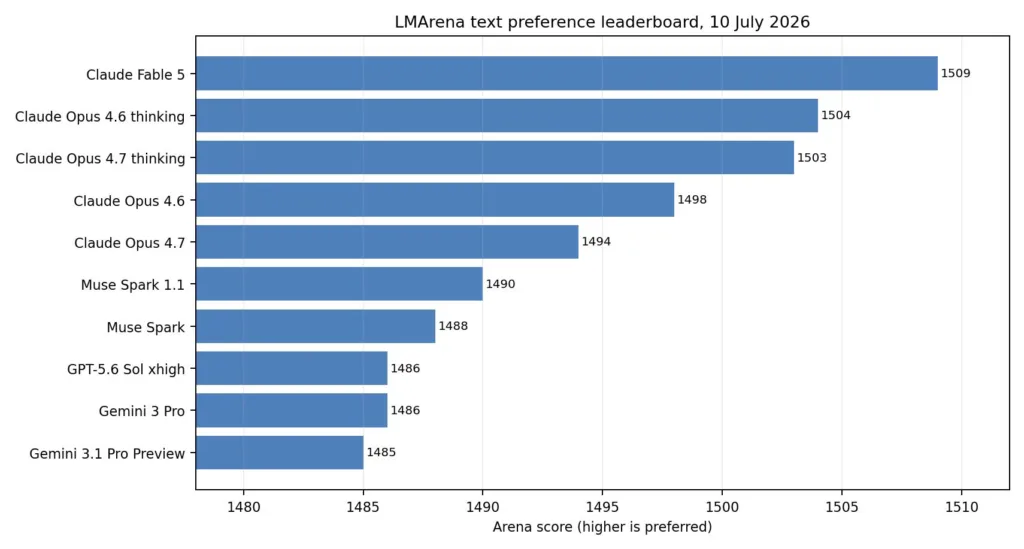
Source: LMArena Text leaderboard. Human preference includes usefulness, style, and presentation.
In the snapshot, Claude Fable 5 led with a score of 1509. Several Claude Opus versions followed closely, while GPT-5.6 Sol and Gemini 3 Pro both scored 1486.
For customer-facing work, that matters. People notice whether an answer feels clear, useful, natural, and easy to follow. A model that performs well here may be a strong candidate for support, sales conversations, writing, or other user-facing tasks.
But preference is only one part of the picture. A high arena score does not prove that a model is more factual, more secure, better at using tools, or more reliable within a business workflow. New models may also have fewer votes, and small score differences may not mean much when uncertainty ranges overlap.
The best way to use this chart is to identify models worth testing for customer experience.
For businesses in software, hardware, or engineering, this snapshot can help narrow the AI models worth testing for technical work.
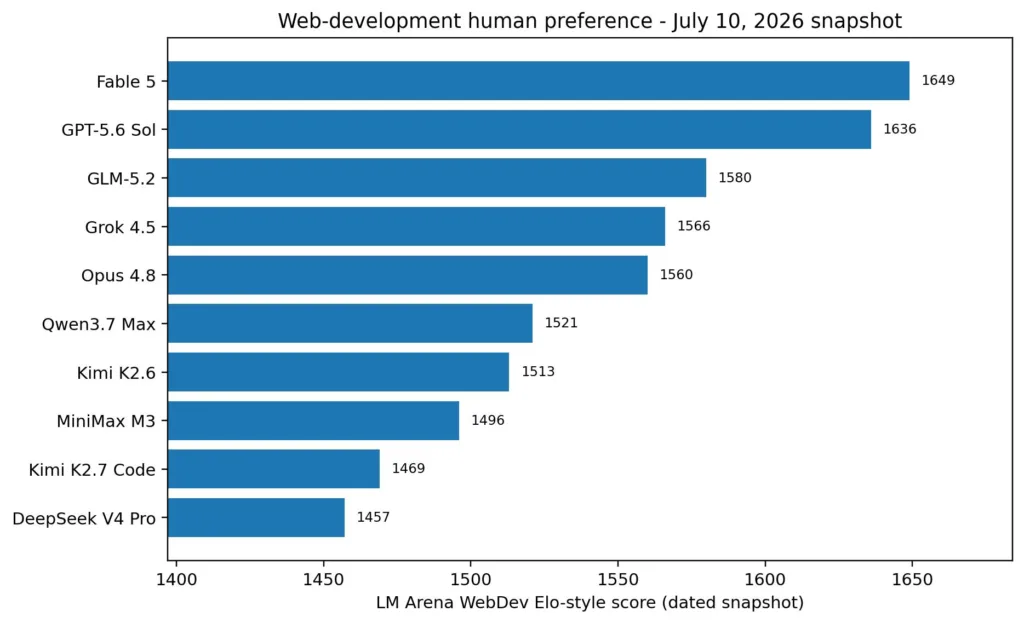
Source: LMArena WebDev leaderboard. The GPT-5.6 row used a Codex harness. The score therefore reflects the model and the surrounding coding system.
In the recent results, Fable 5 ranked first with a score of 1649, followed by GPT-5.6 Sol and GLM-5.2, which placed third at 1580, ahead of Grok 4.5 and Claude Opus 4.8.
That makes Fable 5 and GPT-5.6 Sol strong candidates for complex development tasks, while GLM-5.2 deserves attention from teams looking for an open-weight option for private coding or agent workflows.
However, this is not a complete engineering benchmark. The GPT-5.6 result used a Codex harness, so the score reflects both the model and the surrounding coding system. Human preference also measures how useful and polished the final output feels, not only whether the code is correct, secure, or production-ready.
For software companies, WordPress teams, SaaS products, hardware businesses, and engineering firms, the better next step is a private technical test. Compare each model on the work your team actually handles, such as repository changes, APIs, firmware support, technical documentation, debugging, SQL, security checks, test generation, and backward compatibility.
Choosing an AI model by brand name alone is tempting, but businesses do not buy benchmarks. They buy outcomes.
A customer-support team needs fast responses and safe escalation. A software team needs repository access, testing, and reliable code changes. A privacy-focused company may care more about self-hosting than winning a public leaderboard. That is why the most useful shortlist starts with the work you need the model to complete.
The table below offers practical starting points based on official model documentation, pricing pages, and independent benchmark evidence. It is a shortlist for testing, not a universal ranking.
| Business need | Starting choices | Migliore vestibilità | Main caution | Key sources |
| Maximum general capability | Claude Fable 5 or GPT-5.6 Sol | Complex analysis, high-value research, and difficult planning | Both are premium options. Test them on the exact task before committing. | Artificial Analysis placed Fable 5 and GPT-5.6 Sol close together in its Intelligence Index. |
| Balanced enterprise agent | GPT-5.6 Terra, Claude Sonnet 5, or Gemini 3.5 Flash | Daily knowledge work, tool use, multimodal input, and standard business automation | Lower-cost models may need escalation for difficult or sensitive cases. | OpenAI positions Terra as its balanced GPT-5.6 tier. Google describes Gemini 3.5 Flash as a model for multi-step agentic work, while Anthropic positions Sonnet as its balanced model tier. |
| High-volume support and routing | Gemini 3.1 Flash-Lite, GPT-5.6 Luna, or Claude Haiku 4.5 | Classification, extraction, ticket triage, and short routine responses | Add a stronger model or human review for complaints, refunds, and account changes. | Google describes Flash-Lite as a low-latency model for high-volume workflows. OpenAI positions Luna as its cost-efficient tier, and Anthropic recommends Haiku for fast, cost-sensitive applications. |
| Repository-level coding | GPT-5.6 Sol with Codex; Claude Fable or Opus as a reviewer | Large codebases, terminal work, testing, debugging, and code review | The surrounding coding agent, tools, test policy, and reasoning budget can change the result. | GPT-5.6 Sol led the captured Artificial Analysis Coding Agent Index in the Codex harness. |
| Multimodal documents and media | Gemini 3.1 Pro or Gemini 3.5 Flash | Workflows involving PDFs, images, audio, video, files, and code | Check the exact endpoint, tool charges, context limits, and data-governance terms. | Google lists Gemini 3.1 Pro for complex multimodal reasoning and Gemini 3.5 Flash for agentic and coding tasks at scale. |
| Open or private enterprise deployment | GLM-5.2, Mistral Large 3, or Command A+ | On-premises, private-cloud, sovereign, or customized deployments | Your team becomes responsible for infrastructure, security, monitoring, and updates. | GLM-5.2 is available with long-context support; Mistral Large 3 and Command A+ are released under Apache 2.0 for private deployment. |
| Low-cost open reasoning | DeepSeek V4 Pro or V4 Flash | Repeated reasoning, coding, tool calls, and cost-sensitive agent tasks | The models are still too large to self-host, and regional access or data terms require review. | DeepSeek’s official release describes V4 Pro and Flash as long-context reasoning and agent models, with Flash designed as the smaller and cheaper option. |
| Chinese and English business workflows | Qwen3.7 Max, GLM-5.2, Kimi K2.6, or DeepSeek V4 | Multilingual office work, coding, long-context tasks, and tool-based workflows | Verify international endpoint access, model versions, residency, moderation, billing, and support. | Alibaba recommends Qwen3.7 Max for complex multi-step tasks. Z.ai, Kimi, and DeepSeek document agentic, coding, and long-horizon capabilities. |
| Local workstation assistant | Qwen3-Coder, Gemma 4 12B, Ministral 3 14B, or Devstral Small 2 | Private repositories, offline documents, local coding, and reduced cloud exposure | Real performance depends on RAM, GPU memory, quantization, context size, and runtime support. | Qwen3-Coder supports repository-scale coding, Gemma 4 includes a 12B open model, Ministral 14B is optimized for local use, and Devstral Small 2 targets local software-engineering agents. |
The right choice depends on the specific workload your business needs to handle. Lower-cost options such as Gemini Flash-Lite, GPT-5.6 Luna, e Claude Haiku can handle routine support, ticket sorting, and simple data tasks.
For sales, CRM updates, and daily operations, Terra, Sonnet, e Gemini Flash offer a stronger balance of capability, speed, and cost.
More demanding work, such as software development, technical research, or long document analysis, may need GPT-5.6 Sol, Claude, Gemini Pro, GLM-5.2, o Qwen3-Coder. Teams with stricter privacy needs can also explore open or self-hosted options.
Most businesses do not need one model for everything. A mixed setup usually works better: use a lower-cost model for routine work, send difficult cases to a stronger model, and keep human approval before refunds, account changes, external messages, or other sensitive actions.
Businesses that want to compare complete AI assistants, not just their underlying models, can explore our guide to the migliori alternative a ChatGPT.
Yes. Open-weight AI models can run on a laptop, workstation, or private server. To turn a local AI model into a local AI agent, you add an agent runtime, private memory or RAG, and controlled access to tools such as files, browsers, terminals, or business applications.
The main advantage is control. Sensitive files and private repositories can stay inside your environment. The figure shows how user requests move through a local agent runtime to a local model, private knowledge index, and sandboxed tools.
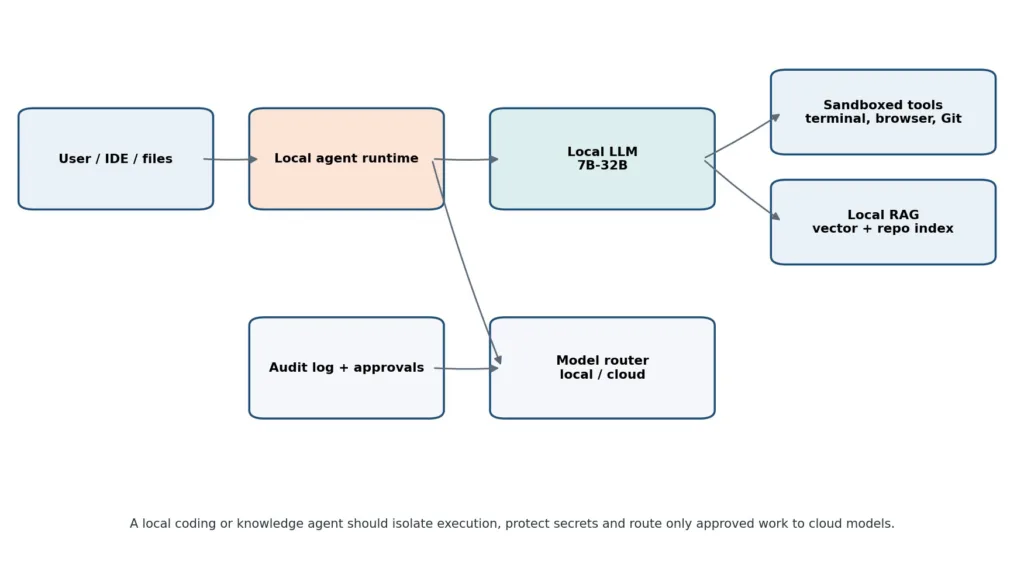
Source: llama.cpp project. Keep repository access local, isolate terminal and browser execution, and send only approved context to a cloud fallback.
Several models fit this setup. Gemma 4 12B e Ministral 3 8B or 14B are practical options for document search, private assistants, and general tool use.
Devstral Small 2 24B is designed for repository-based coding work, while smaller Qwen models can support local coding and Chinese-English tasks. Granite 4.1 8B suits private enterprise search and RAG, and Phi-4 Reasoning Vision 15B can handle documents, images, and interface-related tasks.
Smaller models such as Gemma 4 E2B/E4B o Llama 3.2 1B/3B can run on phones or lighter devices for simple offline work.
The right choice depends on available RAM, GPU memory, model quantization, context length, and the speed your team expects. Smaller models are easier to run, while coding and long-document work may need a stronger workstation.
Local deployment keeps sensitive data under your control, but it still requires secure tool access, updates, monitoring, audit logs, and sandboxing.
For many businesses, a hybrid setup works best: keep private and routine work local, then send only approved, difficult tasks to a cloud model.
The API price may look simple, but it is only the starting point. A business workload can also use web search, browser sessions, code sandboxes, vector databases, external tools, retries, fallback models, monitoring, and human review.
That is why businesses should measure total cost per successful task, not only price per million tokens.
The chart below uses one shared example: 1 million input tokens plus 250,000 output tokens. Under those assumptions, the estimated token-only cost ranges from $0.62 with Gemini 3.1 Flash-Lite a $22.50 with Claude Fable 5, a difference of more than 35 times.
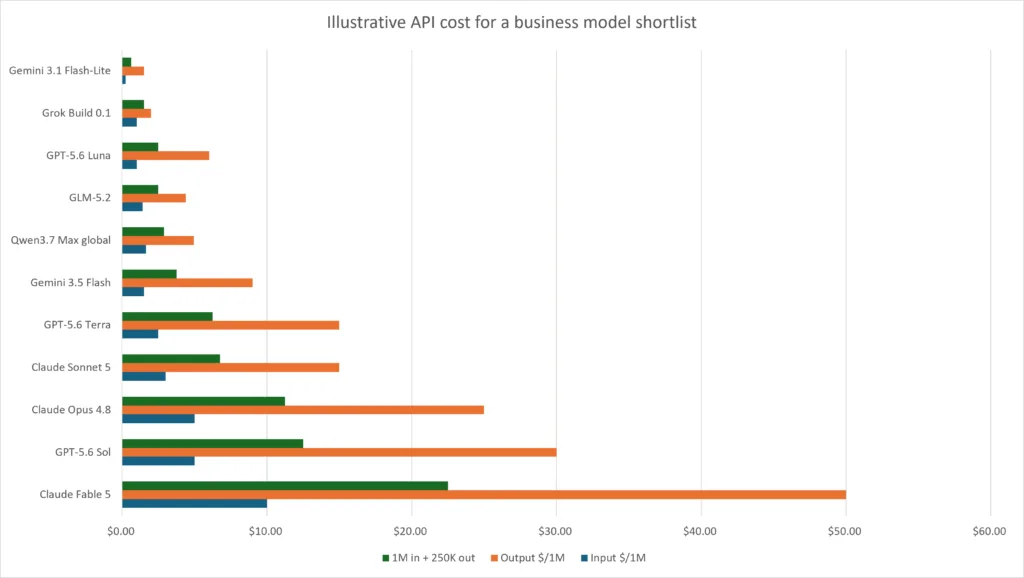
The pricing chart above uses official provider rates, not claims from one vendor.
A recent user example offers another useful signal: developer Dax reported that Claude Fable accounted for about 30% of his team’s model cost, even though the screenshot showed much lower usage than GPT-5.6 Sol. Sam Altman later highlighted that difference in a reply.
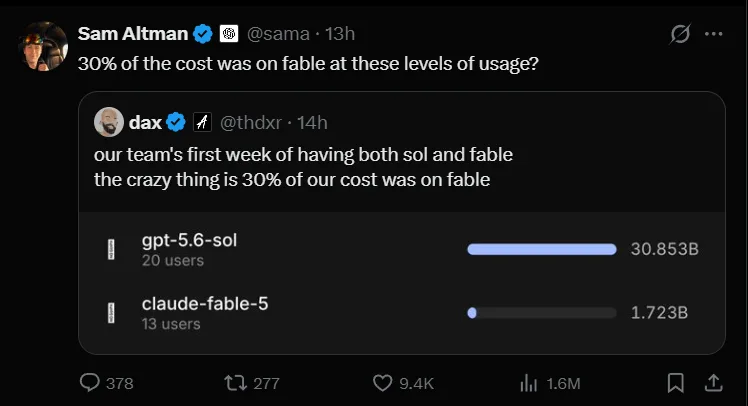
This example should be treated as personal observation, not a controlled benchmark. The two models may have handled different tasks, prompts, output lengths, reasoning settings, or workloads.
Still, it reinforces an important point: token price and usage can create very different bills. Compare models using the same tasks and measure the full cost per successful result, including retries and human review.
Not every business process needs AI. If the steps are predictable, fixed automation is usually faster, cheaper, and easier to control. AI becomes valuable when the workflow requires interpretation, judgment, changing decisions, or handling unexpected situations. Before choosing a chatbot, agent, or model, ask whether AI will improve a measurable result such as response time, accuracy, lead quality, or completed work. If it only replaces a few clicks, automation may be enough.
When comparing the best AI models for business, the right choice is not simply the one that wins the most benchmarks. It is the model that completes your real workload safely, reliably, and at a cost your business can sustain.
Fable and GPT-5.6 Sol belong in the frontier shortlist. Terra, Sonnet, Gemini Flash, Luna, and Flash-Lite provide more control over everyday costs. GLM, DeepSeek, Qwen, MiniMax, Mistral, and Command A+ offer more flexibility for open, private, local, and regional deployment.
Start with one defined workload. Keep predictable steps rule-based, give the model only the tools it needs, and require human approval before sensitive actions. Then measure task success, errors, review time, speed, and total cost per completed outcome.
For teams building automation or AI agent workflows, platforms such as Bit Flows can connect selected AI models with triggers, business rules, applications, approvals, and logs. The goal is not to add AI to every step, but to use the right model only where interpretation or judgment creates real value.
There is no single winner; the best AI model for business depends on the workload, budget, privacy requirements, tools, deployment method, and acceptable error rate.
GPT-5.6 Terra, Claude Sonnet 5, and Gemini 3.5 Flash are practical starting points for daily knowledge work, CRM tasks, content, and business automation.
Gemini Flash-Lite, GPT-5.6 Luna, and Claude Haiku suit routine support, while complaints, refunds, and account changes should move to a stronger model or human reviewer.
ChatGPT Sol and Claude Opus are strong candidates for complex repository work, while GLM-5.2 and Qwen3-Coder offer open-weight options for private coding workflows.
Gemini Pro and Gemini Flash are strong starting points for multimodal workflows involving documents, images, audio, video, files, and code.
Yes, the same model can power a chatbot, copilot, or AI agent depending on the tools, memory, permissions, and workflow built around it.
Most businesses benefit from model routing, using lower-cost models for routine work and stronger models or human review for complex, uncertain, or sensitive cases.
The total cost includes tokens, search, tools, storage, sandboxes, retries, monitoring, and review, so businesses should measure cost per successful task.
The total cost includes tokens, searches, tools, sandboxes, storage, retries, monitoring, and human review, so businesses should compare cost per successful task rather than token price alone.
Yes; open-weight models can run locally, quantized 7B–32B models can support local documents, coding, retrieval, and narrow tools, although hardware, security, updates, context length, and runtime performance still matter.
Choose proprietary models for managed frontier capability and open-weight models for control, customization, or private deployment when your team can manage the infrastructure.
Yes, GLM, DeepSeek, Qwen, Kimi, and MiniMax can support global workloads, but businesses should verify access, privacy, residency, licensing, moderation, and support.
No, benchmarks create a shortlist, but your prompts, tools, data, workflow, error rate, review time, and total cost determine the better business choice.
No, predictable processes are usually better handled with fixed automation, while AI adds value when the work requires interpretation, judgment, or adaptation.
Run identical real tasks with the same data, prompts, tools, permissions, and budgets, then compare success, serious errors, latency, recovery, review time, and cost.
AI models can handle interpretation or judgment while workflow platforms manage triggers, rules, applications, approval steps, and logs around the AI decision.






 IT
IT  EN
EN  DE
DE  ES
ES  NL
NL  PT
PT  JA
JA